The decision to no longer extend State pension and health plan benefits to new employees of UNC Healthcare and ECU Health is detrimental to all North Carolinians.
NCRGEA will continue to work with elected officials to move to a more fiscally sound solution to protect the pension and health plans so as not to increase the risk of retirement insecurity among healthcare workers and their retirees, especially its lowest-paid.
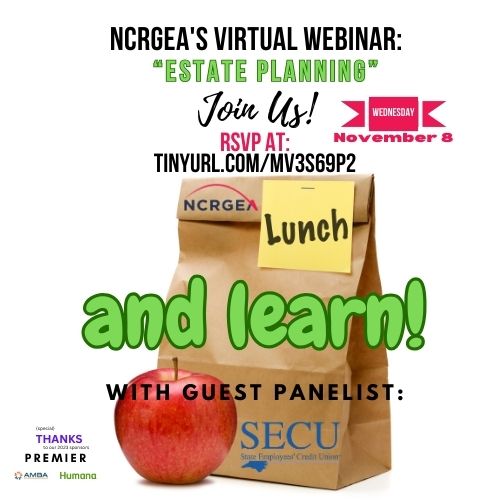
Our speakers will be Katie Kerns and Blake Agnew, District Managers from the Financial Advisory Services group of State Employees’ Credit Union (SECU). This webinar will discuss general estate planning topics, including:
Wills
Trusts
Powers of attorney
Advance health care directives
Estate planning and trust services offered to members by SECU through Members Trust Company
Trust Services offered through Members Trust Company, a federal thrift regulated by the Office of the Comptroller of the Currency. Trust products are not credit union deposits, are not insured by the NCUA or any other federal government agency, are not obligations of or guaranteed by the credit union, Members Trust Company or any affiliated entity, and involve investment risks, including the possible loss of principal.
Registration by Friday | November 3 is required for this FREE event. Click the Register Now button at the top. Space is limited so please register soon. INVITE A FRIEND! You will receive the Zoom link by email on Monday, November 6 and you don’t need a computer to participate! Join the session using either the Zoom link, or the Zoom long distance phone number provided. If you have any questions, please email Deryl@NCRGEA.com or phone 919.834.4652 or 1 800 356 1190.
*This session will not be recorded at the request of our presenters with SECU*
Previous NCRGEA 2023 Lunch and Learn Series recordings can be found on the NCRGEA YouTube channel.
As we age, we become aware that our physical and mental health, as well as dietary and social needs, changes over time. We can maintain control of our health by making the appropriate adjustments.
5 Steps for Healthier Aging
If you’re ready to take charge of your well-being, these easy to accomplish steps can help you keep your body and mind healthy as you age.
1. Get moving
Maintaining regular physical activity can help maintain a healthy weight, lower blood pressure, blood cholesterol, and blood sugar levels.
Aim for at least 150 minutes of moderate-intensity physical activity each week.
Beginning physical activity can be as easy as walking for 10 to 15 minutes for three to four days per week and increasing as you go.
Make your physical activity FUN and something you enjoy doing! If making it social will keep you motivated, ask a friend to be your workout buddy.
2. Maintain a healthy diet
Eating right can help you stave off major health issues like obesity and the risk of diabetes and heart disease.
Eat appropriate portion sizes.
Eat a variety of fresh fruits and vegetables and have them make up half of your plate.
Avoid excessively processed, especially ultra-processed foods.
Stay hydrated- adults should drink between 10-16 cups of water per day, depending on gender, living environment, and activity level.
3. Stay social
Along with increasing cognitive function, and boosting self-confidence and mood, healthy social connections as we get older also improves (and can help even prevent!) symptoms of anxiety and depression.
– Take advantage of technological innovations like attending online or in-person classes (employing appropriate safeguards) that interest you.
– Use Zoom, Facetime, WhatsApp, text messaging, and even a good old-fashioned phone call to stay in touch with friends and family.
– Stay in contact with family and friends through in-person meet-ups.
4. Balance your body and mind
Regular exercise for older adults can not only improve overall fitness levels and quality of life, it also reduce the risk of disability or chronic conditions. Participating in regular physical activity has been shown to have a positive effect on both physical and mental well-being for seniors.
– Maintain a positive attitude.
– Keep your mind active by reading, doing puzzles or other mentally stimulating actions.
– Keep your body active through mindfulness, stretches, yoga and similar pursuits.
5. Be proactive
Receive regular medical, dental, and vision checkups. Many diseases and health issues can be prevented when caught early.
Healthier Aging Starts with Peace of Mind
Life Insurance is the safest path you can take and is something you should have to protect the ones you love. Get a Whole Life policy today to make sure your loved ones are taken care of. You’re guaranteed acceptance, even if you smoke or have weight issues.Plans are available from your very own association and its trusted partner AMBA. Joining is easy: you can purchase your policy online right now. It even includes a no-obligation 60-day return policy. Learn more about a Whole Life Policy through NCRGEA and AMBA at www.ambalifeinsurance.com/ncrgea or call 800-956-1228.
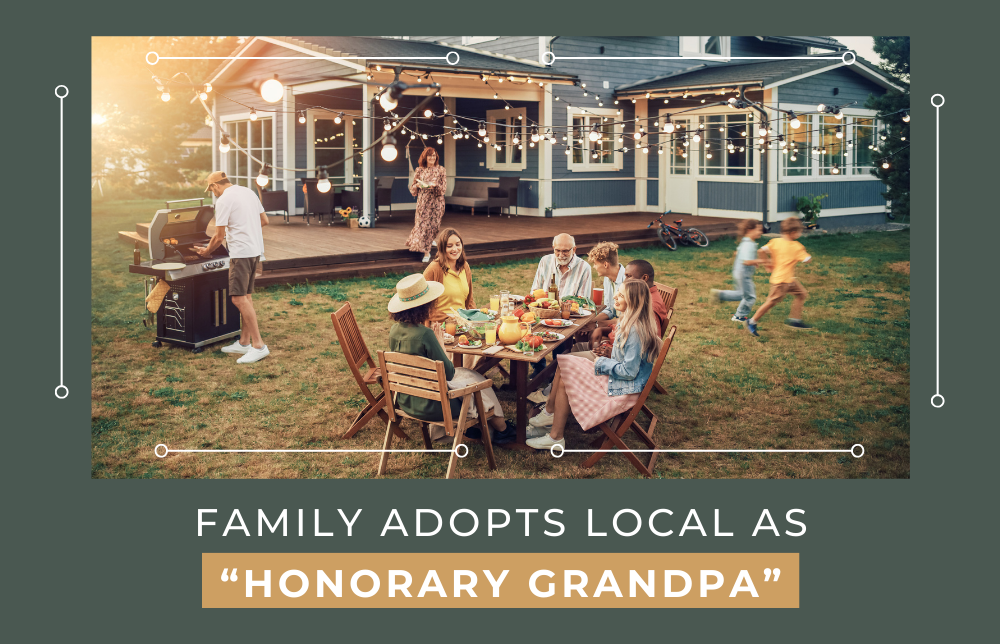
When Wilson and Sharaine Caraballo and their six children moved to Texas from the East Coast, they were looking forward to moving into their new home. Little did they expect that soon they’d be “adopting” a new member to their family.
Sharaine and Wilson were apprehensive when they moved into the new neighborhood. Sharaine, who is originally from Pawtucket, New England, said, “One of my biggest fears was meeting our new neighbors. I was wondering who they were going to be and what they were going to be like. When Paul welcomed us into the neighborhood I knew I had made the right choice.”
But one of the first people to welcome the Caraballos to the neighborhood in March 2022 was 82-year-old Paul Callahan. Callahan’s warm welcome helped put them at ease. He offered helpful advice to the new homeowners and assistance with issues and concerns about their new home.
“He was coming over with tools. He’d bring screwdrivers and teach Wilson how to fix up the garage and Wilson followed all his advice,” explained Sharaine.
The family of eight quickly bonded with Callahan and, to everyone’s delight, Paul took on the role of de-facto grandpa.
The Caraballos and Paul now see each other every other day. They invite him to all family cookouts, and spend every holiday together, and this Father’s Day, Paul received a new outfit from the family as a present.
The warmth is mutual. “He’s always coming over with little trinkets for the kids,” Sharaine continues, “They play with him a lot and call him Uncle Paul. He’s got stories for days.”
Sharaine’s kids love Paul as much as she does. Likewise, the older man does what he can to contribute to making them feel at home too. As much as Paul helps the family, Sharaine knows her family plays an important role in keeping Paul feeling social and vital.
“I asked what drew him to us and he said he was a very social person and that he grew up around lots of kids,” she said. “‘That’s how I grew up, my house was always where everybody hung out.’
Staying social and feeling like you’re contributing to making others feel better is important throughout our lives, and especially as we get older. NCRGEA provides many opportunities to rub elbows with peers. Everything from association meetings to volunteering opportunities to group travel. There’s no reason to go it alone. Join the group! Visit rgea.info/membership or call 800-956-1228 to learn about membership and social options and enjoy being among friends.
Free virtual webinar Lunch & Learn Series: “All About Long Term Care and Elder Care.”
Our speaker will be Jon Green from our benefits partner, AMBA. This webinar will discuss:
Identify the Myths and Facts Surrounding Care and Who Pays for What
Discuss the need for Long Term Care Protection
Discuss the Traditional Components of Long-Term Care
Learn the Costs of Care in North Carolina
Discover the Potential Solutions and make the Most of your Endorsed Options
Registration by Sunday | October 1 is required for this FREE event. Click the Register Now button at the top. Space is limited so please register soon. INVITE A FRIEND! You will receive the Zoom link by email on Monday, October 2 and you don’t need a computer to participate! Join the session using either the Zoom link, or the Zoom long distance phone number provided. If you have any questions, please email info@NCRGEA.com or phone 919.834.4652 or 1 800 356 1190.
Previous NCRGEA 2023 Lunch and Learn Series recordings can be found on the NCRGEA YouTube channel.
If you want to join our NCRGEA team, or just raise funds and contribute under the “NCRGEA Walkers” team, we have until December 31, 2023 to collect funds. Or choose from a local walk event near you!
1) Go to website: www.alz.org/walk 2) Click on “Find a Team” at the top of the webpage: 3) Enter our team name “NCRGEA Walkers” in the “Find a Team” search box, click Search 4) Click on the “Event” link for Raleigh 5) Make your choice to Register as a walker or Donate to Alzheimer’s Walk
In order to participate, you only need to meet the following requirements:
1. Must be at least 65 years of age. 2. Live in Forsyth County. 3. Must get free tickets from Break Time Billiards or Shepherd’s Center. 4. Must take ticket to Break Time Billiard’s counter to receive your free lessons and to play pool. Sign in sheet is at the counter.
Once you have your ticket, you can play during program hours:
Monday–Thursday from 4–6:00pm Friday from 12–6:00pm
NCRGEA member and District 3 Community Advisory Board (CAB) member, Robin Kelly, is a certified pool instructor and he is there to greet you. To schedule lessons, call Robin at: 336-466-0683. He instructs during program times and is excited to work with you and teach a sport he loves.
For additional information regarding the program, please contact Shepherd’s Center at 336-748-0217.
No doubt, this is a great opportunity to stay active and engaged! We are hoping that you will take advantage and enjoy mingling with others around this sport! NCRGEA membership is not required, so please include your retired friends. Robin may ask you to pose for a picture for our newsletter.
The info flyer is available here, and as always, if you have any questions, please email deryl@NCRGEA.com or phone 919.834.4652 or 1.800.356.1190.
Hear directly from Lisa Wallace, a Social Security Public Affairs Specialist with the Social Security Administration. This webinar will discuss:
eligibility for benefits
how early retirement affects your benefits
disability and survivor benefits
the future of Social Security
filing for Medicare
Registration by Monday | September 4 is required for this FREE event. Click the Register Now button at the top. Space is limited so please register soon. INVITE A FRIEND! You will receive the Zoom link by email on Monday, September 4 and you don’t need a computer to participate! Join the session using either the Zoom link, or the Zoom long distance phone number provided. If you have any questions, please email info@NCRGEA.com or phone 919.834.4652 or 1 800 356 1190.
This session will not be recorded at the request of Social Security Administration.
Previous NCRGEA 2023 Lunch and Learn Series recordings can be found on our YouTube channel.
North Carolina’s strength, beauty, language, and allure come from its land as much as the people who reside in its 100 counties and 552 distinct municipalities. It’s no wonder that our great state has held the distinction of having more dialects than any other state in the United States, driven by its diverse geography from the mountains to sea and the people who have inhabited it from the past to the present. From the lush 221 square miles of Clay County in the far western corner of our state to the expansive Dare County in the east with its 1,562 square miles — we have something special.
The governance of these distinct and unique areas of the state consisting of cities, towns, and villages is consequentially complex, due to the variety of needs dependent on population, geography, and economic factors. The General Assembly grants charter authority for each entity to operate as a governing body under the state statutes and constitution. Hyde County’s three residents per square mile require fewer government services than Mecklenburg County’s 2,055 residents per square mile, though each scenario brings its own challenges to the citizens, county managers, and commissioners. Services offered to residents — and even the benefits offered to local government employees — can vary fairly dramatically. A prime example of this difference in benefits is participation in the Local Government Employees Retirement System (LGERS), which is an optional benefit that may or may not be offered by county our municipality.
LGERS is administered by the Office of the Treasurer and relies on its Board of Trustees to act as the decision-making body regarding its policies and operations. The LGERS Board of Trustees is comprised of 13 members with some serving on the TSERS Board as well. Among the Trustees are its two ex-officio members, the State Treasurer (who chairs the Board), and the Superintendent of Public Instruction. Two appointments are made by the General Assembly, and the Governor appoints eight members representing local government in these areas:
A mayor or member of a governing body in a city or town
A city manager
A county manager
A county commissioner
A law enforcement employee
A local government employee
A retired government employee
An active or retired member of the Rescue Squad Workers’ Pension Fund
Prior to 2006, the General Assembly provided cost-of-living adjustments (COLA) to LGERS participants as part of its budget legislation process. Since 2006, it has delegated responsibility to the LGERS Trustees, but within the framework of these existing legislative restrictions:
Currently allows them to provide up to 4% as long it does not exceed the Consumer Price Index.
Only allows a COLA to be paid based on record of investment gains and losses during the preceding three-year period.
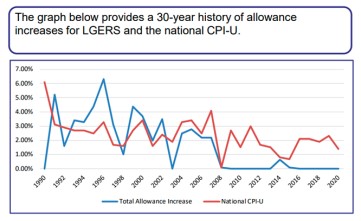
As the chart below shows, investment losses with the 2008 Great Recession set a course for the widest historical disparity between retirement disbursements and inflation. What is not reflected on this chart, from 2021 to present, is an additional 16% increase in the CPI-U (inflation rate).
To put context to these roughly 30 months, is the reduction in buying power is nearly the same as what occurred in the decade between 2010-2020 (17.6 %). The current reality brings stagnated cost-of-living adjustments for retirees, with contributing factors being changes in the legislative administration of LGERS, rising costs to the counties and municipalities to level up the fund, and the actuarial lowering of return expectations for the fund.
I share this information with NCRGEA members, with the general public, and with any of our elected leaders so that, together, a dialogue can begin on finding opportunities to begin moving forward — away from the current state of “no COLA” for government retirees. TSERS and LGERS participants have significant shared histories and outcomes in regard to COLA. But some unique components of LGERS compared to other pensions managed by the Office of the Treasurer will require broader partner collaborations to resolve these COLA challenges. Casting the vision for a prosperous North Carolina will require a vision for the significant portion of its citizens who work and retire from public service, or North Carolina will fall short of its full potential.
In closing, I leave you with a quote by Albert Einstein that “no problem can be solved from the same level of consciousness that created it.” In context of this message on LGERS, the forces that brought us to this point are to be noted but cannot tether new and innovative ways to improve the lives of governmental retirees, maintain a talented and loyal public service workforce, and encourage the broader economic prosperity of North Carolina.
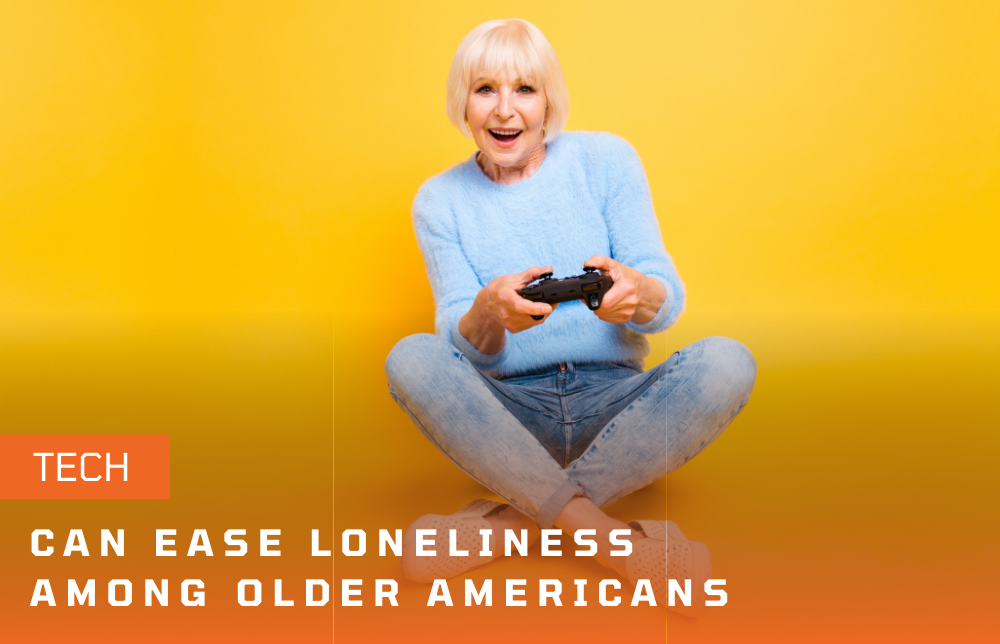
In 2018, Great Britain made history by appointing a Minister of Loneliness. The objective for the role was to study how the effects of chronic loneliness effect the 7.1% percent of British citizens who suffer from it and how to reduce those numbers.
The United States faces its own battle against the same issue. In America an epidemic of loneliness is an “under-appreciated public health crisis,” according to Surgeon General Vivek Murthy. Even before the Covid-19 pandemic, almost 50% of adults in the United States reported measurable levels of loneliness.
Studies have shown that the condition can affect mental and physical health, with heightened risks for catching a cold, having a stroke or heart disease, slipping into early cognitive decline, and developing depression.
Loneliness and Social Isolation Among Older Americans
Isolation and loneliness are different experiences. There are many people who are socially isolated who don’t experience loneliness. Likewise, there are also many people who experience loneliness despite being surrounded with others, including friends and family.
So, which causes health problems, especially as we age: social isolation or loneliness?
As it turns out, both.
Even for those who prefer solitude and have a more introverted personality, interaction with others turns out to help keep our minds and bodies more active and engaged and helps ward off depression and loneliness.
Although technology is no substitute for our need for more face-to-face contact with others, it can serve an important role to bridge the gap and help find likeminded people.
Find People with Similar Interests
No matter how obscure or specialized the subject, from the best diners along Route 66 to Big Band Jazz, online social media is filled with active and enthusiastic communities. Some may be local to you and have in-person meet-ups and others may hold regularly scheduled online video discussions through Skype or Zoom.
Finding those with similar experiences and interests can help you form bonds that grow into real-world friendships. That’s important: one survey found that 46% of those who become personal friends with “online acquaintances” are less likely to be lonely than those who maintain online-only relationships.
Convenient Rides Help More Social Activities
One reason for social isolation among older Americans is their inability or concern to drive at night or in heavy traffic. Apps like Uber and Lyft can be a game-changer, helping people to get out and socialize with friends.
Play Online Games
One of the best ways to keep the aging brain nimble and active is to play games. Online games like Words with Friends (a game much very similar to Scrabble) let people play in real time with friends gathered from social media and their phone contacts. Many of these games include built-in chat functions, so the experience of online game play can feel more like sitting across the table from each other, with opportunities for crosstalk, off-topic banter, and “real” conversation between turns.
Virtual Education and Clubs
Virtual book clubs, movie clubs, spirituality and religious groups, and even world-class education courses can be delivered over phones, tablets, or internet-connected televisions. Related discussion groups can provide structured activities that help build relationships.
Finally, take heart. Making new friends may seem daunting, but studies reveal that adults only need to spend approximately 90 minutes in each other’s presence to become friends, while close friendships seem to form over a course of about 200 hours.
Another excellent source to meet like-minded people and potential friends is through your very own association. Everything from association meetings to volunteering opportunities to group travel. There’s no reason to go it alone. Join the group!