Gardening for Good

Spring Edition 2024 | Living Power Magazine
Of all the post-retirement activities and hobbies, gardening ranks among the top pursuits of those with more time to spend on the things they love—and no wonder. A study published last year in the journal The Lancet Planetary Health found people who garden, particularly in community gardens, increased their overall well-being by exercising more, eating more fiber, and staying connected to others in their community. A 2018 study from the journal Clinical Medicine found that gardening reduces stress and can also lower the risk of developing dementia.

The benefits of gardening, however, go far beyond the personal. Some have found ways to garden that also benefit the environment, those with food insecurity, and the community at large.

Master Plan

In 1979, NC State Extension launched its volunteer initiative to help guide homeowners in making environmentally sound decisions in their landscapes. Now 45 years later, the NC State Extension Master GardenerSM program has grown to an extensive network with outposts in every county in the state, with volunteer opportunities in 75 counties.

“These are programs that engage people from the community—local citizens and residents and people who are interested in learning more and also want to volunteer,” says Charlotte Glen, NC State Extension Master Gardener program manager.

The Extension Master Gardener program isn’t simply a horticulture class. While participants do learn about gardening best practices during their training—which includes 40 hours of instruction and a 40-hour internship—those skills simply serve as the basis of the real work done by volunteers.

Once trained through their local extension office, volunteers begin working in their communities on projects that include installing plant labels with QR codes linked to the Extension Gardener Plant Toolbox—the extension’s plant database—in demonstration gardens. Both those initiatives, alongside workshops and other educational outreach, are designed to educate the community about growing their own food, as well as planting gardens that benefit local ecosystems.

“With our Extension Master Gardener program, we’re focusing on home gardening,” Glen says. “The goal is improving quality of life and helping people have access to fresh fruits and vegetables and helping people take care of their yard in a way that protects the environment.”

Extension Master Gardener volunteers also have been instrumental in setting up and maintaining community gardens across the state. These gardens, along with home gardening initiatives, have become an important part of the Extension’s work to reduce food insecurity in North Carolina.

“There are a lot of different activities across the state around helping people grow their own food, whether it’s starting a garden in their yard, being more successful with their gardening, or working with community gardens,” Glen says. “It’s building local production so people don’t have to rely on food being shipped in from somewhere else to a grocery store that may be miles from their home.”
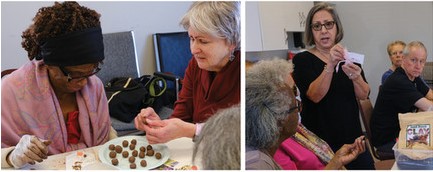
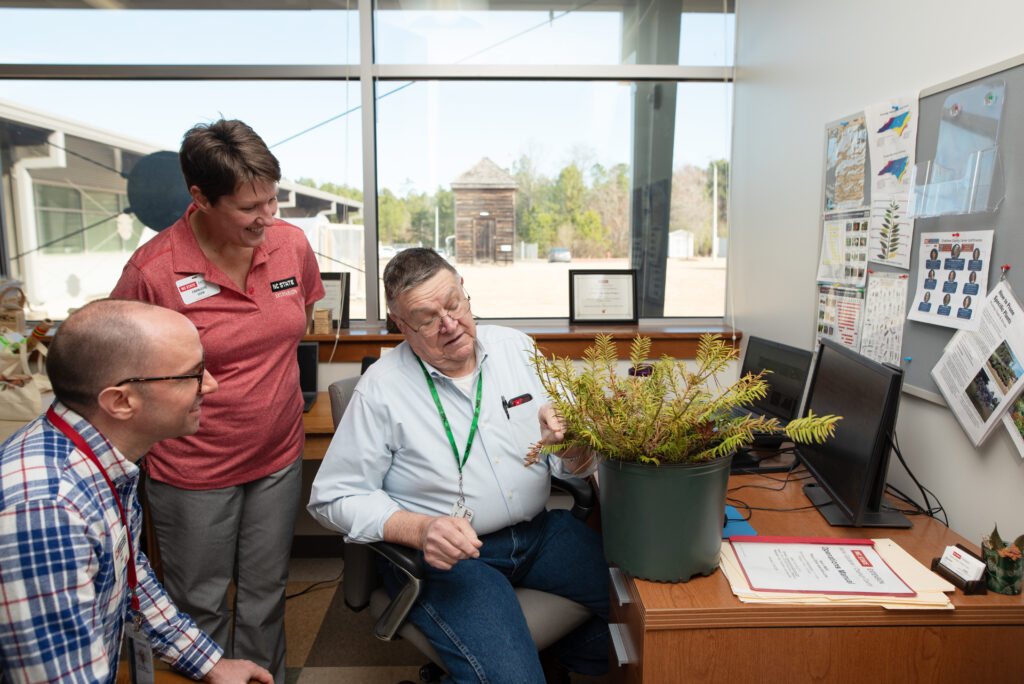
Extension Master Gardener volunteers Ann Farnham (left) and
Susan Levy (right) lead therapeutic horticulture activities for
groups at the Siler City Center for Active Living.
Photos by Steve Broscious

Some Extension Master Gardener volunteers also operate therapeutic gardening programs, designed to improve both physical and mental health in their community. “They’re helping people through gardening, basically helping them improve their health and wellbeing,” Glen says. “The program helps whether it’s physically through the exercise of gardening, or mentally, because there are so many benefits of being around plants.”

Master Gardener volunteers also sometimes get to be a part of statewide research initiatives conducted by NC State, such as a recent study that explored how managing perennial stems increases the ability of residential landscapes to provide habitat for some pollinators, such as bee and wasp species that live and reproduce in plant stems.

“We had volunteers in different counties across the state collecting stems and sending them to some of our researchers on campus, and lo and behold, they found pollinators in them,” Glen says. “And that’s the land grant’s mission—to do research and then through Extension, take that information out to the people and make a difference.”

Glen says the Extension Master Gardener program offers a wide range of roles across the state, and no matter the job, those who give their time can be certain they’re making a difference in not only their community, but the world. “It’s not just a gardening class,” she says. “It’s for people who want to learn about gardening, and then use that knowledge to help others.”

To learn more about the NC State Extension Master Gardener volunteer program, visit EMGV.CES.NCSU.edu.

A Fresh Perspective

During her tenure as principal of a K–12 school that catered to students with significant intellectual and physical disabilities, Kelli Howe knew she wanted to enact programs that would prepare these kids to obtain jobs upon graduation.

Outside the facility, several old greenhouses stood in a state of disrepair, remnants of a horticulture program the school offered during the 1970s and ‘80s. Howe thought they could be salvaged and obtained funding from the school board to refurbish them. Around that time, an acquaintance brought Howe an article about the Charlotte-based nonprofit 100 Gardens, which builds and operates aquaponic gardens in schools, prisons, and communities in need.

“I learned about aquaponics and it seemed to be the perfect fit because it’s very repetitive, predictable, and schedule-driven, which is what a lot of special needs students, especially students with autism, need,” she says.

Aquaponics is a farming method that raises edible freshwater fish and vegetables together in a symbiotic environment. A tank holds fish, such as tilapia or catfish, which provide natural fertilizer for vegetables that are rooted in water in a separate tank. The vegetables absorb nutrients from that fertilizer, providing clean water that goes back to the fish.
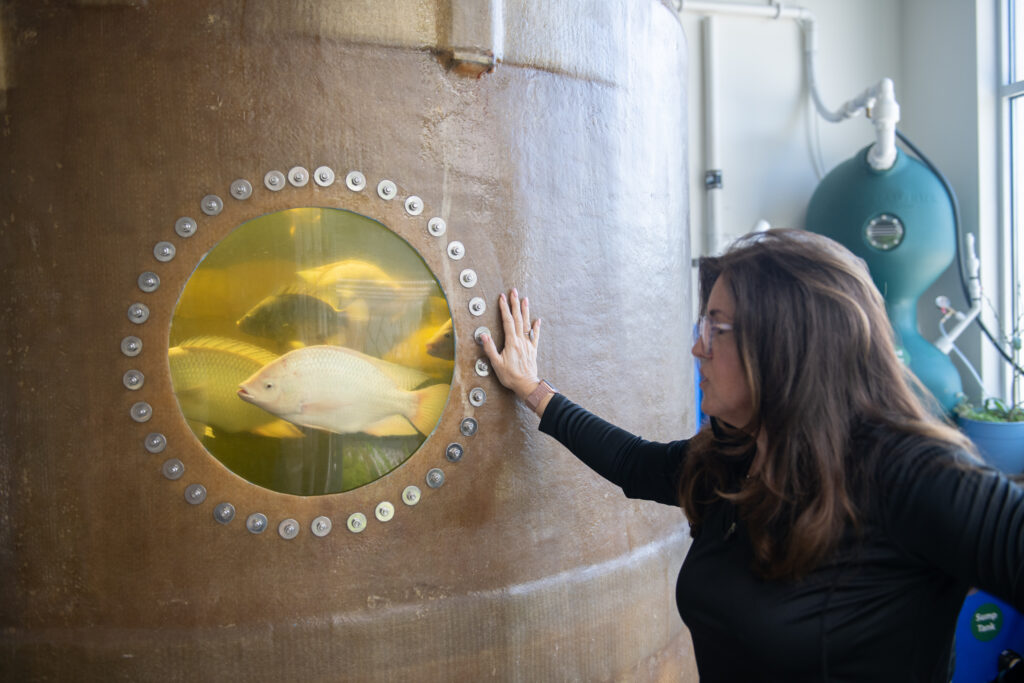
“We started off in a very small way—we raised about $2,500 and got one very small table, one tank, and seven fish,” Howe says. “We trialed that for about five months, and the kids loved it.”

That first tank led to a larger enterprise at the school that still operates today and provides all the lettuce for a local restaurant. After Howe retired, she joined the board of 100 Gardens and now works with the nonprofit as education director to install aquaponic systems in schools and other locations across North Carolina. She says she enjoys the work she does with 100 Gardens not only because it’s fun, but also because it gives her a chance to enact change that can potentially improve our environment.

“It’s a relationship—aquaponics is a symbiotic system, and that’s the same way I’ve always felt about the earth,” she says. “These gardens are a way to show people their impact on the earth and how if we don’t improve our situation, we will no longer be able to garden outside. It just gives a different perspective.”

To learn more about aquaponics, visit 100Gardens.org.

Sustainable Seeds

Teri Stanley has always loved gardening. Growing up in a farming family, she developed an early appreciation for cultivating plants, be they vegetables or flowers. After retiring from Nash County Schools, Stanley dedicated more time to gardening, and she found she liked starting from scratch with seeds rather than buying plants.

“I like flowers, and it’s nice to plant from seeds, so you know what you’re getting,” she says. “I also like to have fresh vegetables—it’s nice to go in the yard and pick things and know where they came from.”
While the growing season is pretty long in North Carolina, Stanley says you have to start planting prior to the last frost to have flowers and vegetables—which can take months to grow—ready when summer hits. So she devised a way to recycle items from her home to create mini-greenhouses for seedlings.

Stanley uses empty plastic juice bottles and milk jugs filled with dirt to plant her seeds, putting them outside in her raised beds to grow. She says not only do the containers protect the tender sprouts from the cold, bugs, and birds, but they also facilitate a more conducive growing environment than indoors.
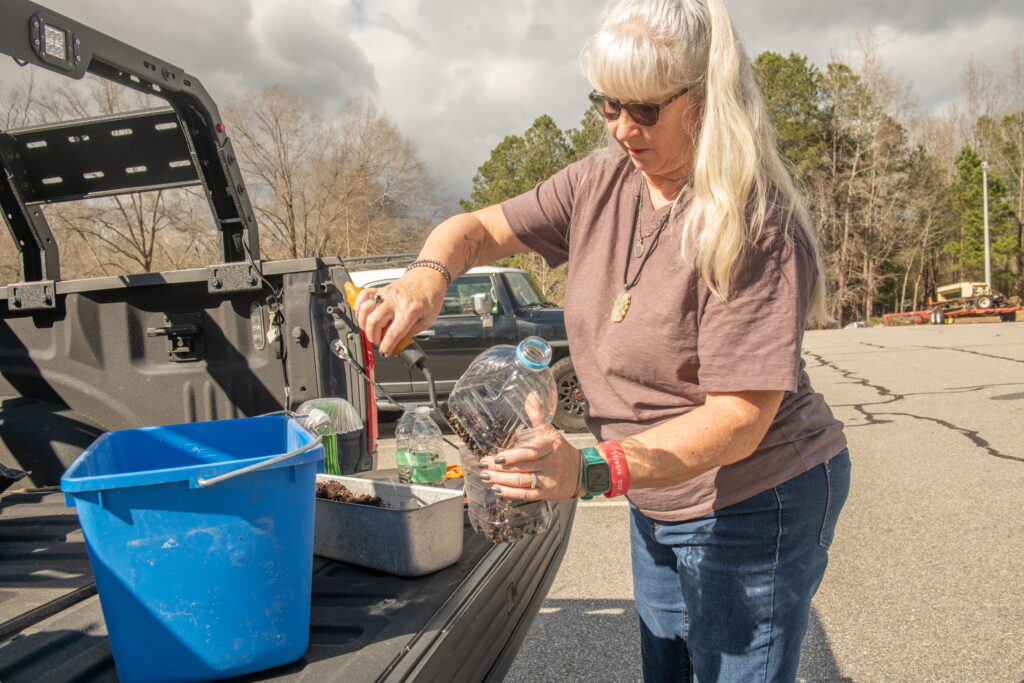
“When you grow seeds inside, they get kind of leggy, and this keeps them from getting leggy,” she says. “Plus, they are more acclimated to being outside, so it’s easier to transplant them from the container.”

Stanley says her homemade greenhouses allow her to garden not only more successfully, but more sustainably, as well. And she says this method reduces the investment in planting a garden, making it accessible to just about anyone.

“I try to recycle as much as I can,” she says. “And with that and a packet of seeds, even if you don’t have good luck with your plants, you’re wasting maybe a dollar or 50 cents. But I promise you, if those seeds do come up, they will make you feel so good.”
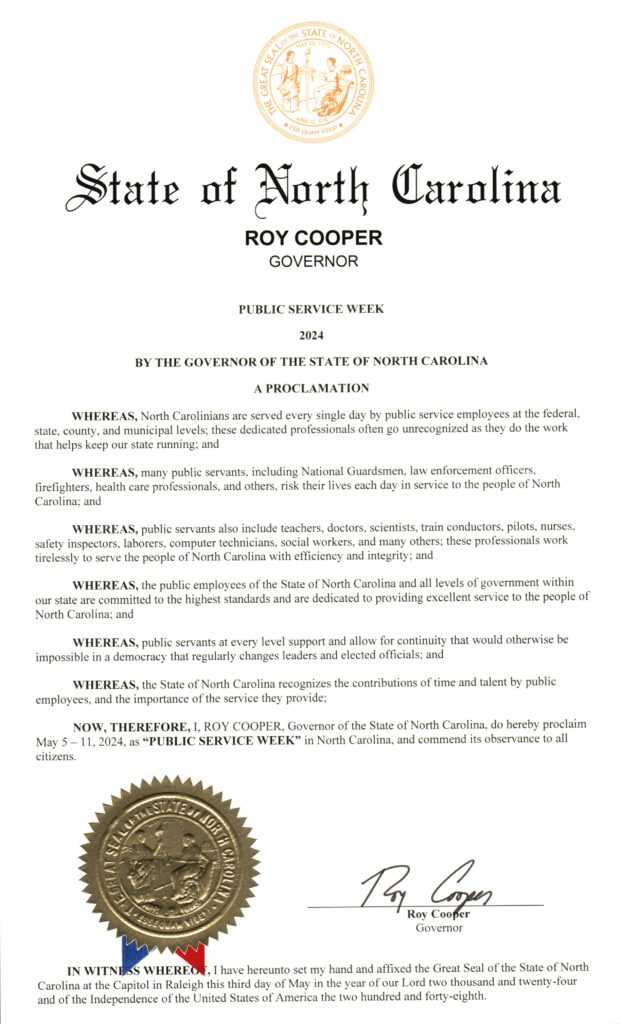
2024 Public Service Week

Governor Cooper has proclaimed May 5-11, 2024 as Public Service Week in the great state of North Carolina. The purpose of celebrating this week is to admire and honor the people who deliver public service and make everyday chores possible for us.

In North Carolina, public service employees have been and remain the main contributors to the many accolades our state has received. They are professional, dedicated, and knowledgeable and can be depended on to keep our state and its many communities running smoothly.

So, this week, join NCRGEA in raising a glass to the people employed in the public sector and shine the spotlight on their work.

President’s Message

by Dr. Michael Taylor | Spring 2024 Living Power Magazine

Desire to Serve Others

The Japanese have a concept called IKIGAI (ee-kee-gay), which loosely translates into the happiness of always being busy doing something you love. IKIGAI combines your passion (what you love doing) with your vocation (what you are good at), with what the world needs (the job market), and finally, what you can get paid to do!

As retirees, we all followed different paths into the public sector. Maybe it was a family history of public service or perhaps somebody who inspired us. A teacher told me a kind and caring high school teacher inspired her to spend a career in the classroom. As retired public servants, we are fortunate because there were so many opportunities in the public sector that allowed us to find a calling that fits our passion and our mission.

One size does not fit all when it comes to our enthusiasm for public service, so the Japanese concept of IKIEGA sounds right. In the days of black-and-white TV, Frank Lovejoy was the lead detective in a crime drama called “Naked City.” No, it was not a show about a nudist colony; instead, it was a story about crime in a city with eight million people. The show opened with, “There are eight million stories in the naked city.” There are that many stories and more about why our members devoted their careers to public service.

One association member, who served in county government, explained it this way: “This was an opportunity to make a difference in people’s lives and to help provide them with opportunities to be successful. And not just individuals, but the job impacted the quality of life in entire communities.”

Another retiree, who worked in technology in county government, was inspired by her father to go into public service. She explains she was a second-generation public servant. “My father was a postmaster, and I grew up watching his devotion to serving the public.”

Family played a role in the decision of another NCRGEA member who was a social worker. “Having experienced a challenging childhood with divorced parents and relocation of the family at a critical age for me, I felt the best way to help children and families in crisis was through social work. The reward was certainly not financial but absolutely the satisfaction of enhancing healthy families.”

Still, another member who retired from the community college system explained it this way. “I have loved every aspect of my career because I was helping to build something or helping people have a better quality of life.”

And finally, a public education retiree noted his grandfather was a Chief of Police, and his mother was a first-grade teacher. He explained, “Those of us who began work in the sixties understood the theme of the time was more about ‘we’ than ‘me.’

That’s what public servants do; they aspire to help the ‘we,’ WE wanted to help.”

President’s Path

As for me, the road began as a student at Lenoir Community College in Kinston, where a group of dedicated and hard-working faculty and staff convinced a kid who graduated from high school in half of the class that made the top half possible, he was capable of so much more. Not only did I get my first degree there, but the desire to be like those who inspired me. This led to a 32-year career in our great community college system.

NCRGEA has over 65,000 members. If I could talk to all of you, I am certain I would hear many different stories about the roads you followed into public service. Yes, different stories, but somewhere in each of those stories would be the same passion to serve others, to make a difference. As one person I spoke with said, “My job was a higher calling.”

One of my duties as President of NCRGEA is to pen a column for every edition of Living Power. This is my final column, as my two-year term as NCRGEA president is over in June. During these two years, I have had a chance to visit with many of you at district conferences (Winston-Salem, Hendersonville, Shelby, Durham, Fayetteville, Morehead City, Greenville, Concord, and Raleigh) and at our legislative days in Raleigh, and even on Zoom. It has been an honor to represent such a great group of people who have dedicated their careers to the service of others.

In thinking about the subject matter for this final column, I considered several topics, including all the changes at your association over the past two years, along with the challenges we face as an organization. But finally, I thought the best topic would be to consider exactly what we all shared during our careers: a desire to serve others.

AMBA’s May Recipe: Mediterranean-Style Salmon Burgers

Everybody loves a good burger, right? They’re delicious and can satiate even the biggest appetite. However, the trans-fats and high calories of traditional burgers have significant health concerns. No worries! AMBA has a fresh beef-free spin on this family favorite that delivers juicy flavors and heart-healthy omega fats and protein.

These salmon burgers will surely be a crowd-pleaser at the dinner table or a weekend get-together. You can serve them on a bun with arugula, tomatoes, onions, and Tzatziki sauce. Or, for a low-carb option, serve them on a bed of lettuce and sliced seasonal vegetables dressed with lemon and olive oil.

Ingredients

  • 1½ lb. skinless salmon fillet
  • 2 tsp Dijon mustard
  • 2-3 tbsp minced green onion
  • 1 cup parsley
  • 1 tsp ground coriander
  • 1 tsp ground sumac
  • ½ tsp paprika
  • ½ tsp black pepper
  • ½ cup breadcrumbs
  • 3 tbsp of extra virgin olive oil
  • A dash of kosher salt
  • One lemon

Directions to Make Mediterranean-Style Salmon Burgers

1) Cut salmon into bite-sized chunks. Place about ¼ of the salmon in the bowl of a large food processor. Add the Dijon mustard and run the processor until the mixture is pasty. Transfer to a large mixing bowl.

2) Place the remaining salmon in the food processor. Pulse a couple of times until it’s coarsely chopped into ¼-inch pieces. Be sure to maintain some texture without getting pasty. Add the finely processed salmon to the bowl.

3) Add the minced green onions and chopped parsley to the bowl—season with coriander, sumac, paprika, and black pepper. Add the kosher salt and mix until combined. Cover and chill for approximately 30 minutes.

4) As the salmon chills, slice a tomato and red onion. Line a sheet pan with parchment paper and a plate with paper towels.

5) Sprinkle the breadcrumbs on a plate. Divide the chilled salmon mixture into four equal portions and form into 1-inch-thick patties. Place each patty in the breadcrumbs and press to coat on each side. Place the breaded salmon patties on the lined sheet pan.

6) Heat 3 tablespoons of olive oil over medium-high. Lower each of the patties into the hot oil. Cook until lightly browned on the bottom, then flip. Cook for about 4 minutes or until the patty is medium-rare and lightly browned on both sides. Adjust heat as necessary during cooking.

7) Set cooked salmon burgers onto the paper towel-lined plate to drain. Sprinkle lightly with salt and a squeeze of fresh lemon juice. Spread with a bit of tzatziki sauce.

8) Layer on the arugula, tomato, and onion slices. Enjoy!

Why Emergency Medical Transportation Can Be So Expensive and How You Can Protect Yourself

People who have needed an ambulance frequently ask the same question when they receive the bill: “How is the cost of the ambulance so expensive?” Why should a short ride to a nearby hospital cost significantly more than an Uber ride? The reason is simple: an Uber ride only needs to get a passenger to their location. On the other hand, an ambulance ride is designed to provide vital assistance to someone experiencing a medical emergency and deliver them to the hospital. AMBA can help you understand why medical transportation can be so expensive and how to help avoid paying this out of your own pocket.

Labor, Training, Readiness, and Equipment

Emergency medical teams need hands-on experience in dealing with emergencies. In addition to the cost of training Emergency Medical Services personnel, having at least two people for every patient in an ambulance is often necessary.

People who receive ambulance transportation pay for the services they receive and the cost of making ambulances readily available.

All equipment and staff must also meet local and state regulatory requirements. The cost of this maintenance rapidly adds up. Treatment equipment to stabilize the trauma patient before reaching the hospital can include emergency ventilators, stretchers, cardiac monitors, infusion pumps, nebulizer machines, oxygen, and more.

What if the patient receives no additional care during the ambulance ride? Unfortunately, these services frequently don’t itemize the care or medications a patient may receive during an ambulance ride. Patients are charged for one of two types of care: essential life support or advanced life support.

In fact, the ride is the least expensive part of an ambulance trip. The mileage charge generally makes up the most minor portion of the final bill.

No matter the financial cost, the priority is to get trauma patients to the hospital as quickly and safely as possible. An Uber ride is no substitute for the care an experienced EMS team with vital, life-saving equipment can provide.

AMBA Can Help Protect You from the Cost of Emergency Medical Transportation

NCRGEA and AMBA can protect your savings with a Medical Air Services Association (MASA) plan. MASA provides lifesaving emergency transportation services. Services are paid in full, with no deductibles, co-pays, or dollar limits. MASA covers your ambulance or airlift in all 50 states and Canada, regardless of your age or medical condition.

Your care is the most important thing in a medical emergency. You can make the cost worry-free by signing up today. NCRGEA and AMBA make getting MASA easy. You can even sign up online. Learn more at www.AMBAmedtransport.com/NCRGEA or call 800-956-1228 Mon.-Fri 9am-6pm ET.

The Negative Effects of Too Much Screen Time on Vision – and Overall – Health

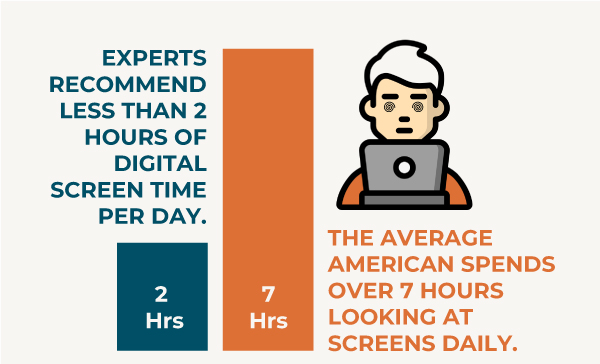
How much time do you spend each day looking at a digital screen? You might be surprised by how much time is spent looking at a computer screen, television, phone, or tablet. What might also surprise you is how far we exceed the recommended hours. AMBA is here to provide the information you need and help you care for your eyes and overall health.

Why Excessive Screen Time Can Affect Your Vision

Our eyes need to focus and move more when looking at screens. As a result, screen usage can contribute to eye health issues. Additionally, the constant exposure to blue light, standard in many digital devices, can make our eyes extremely sensitive to light.

Digital eye strain symptoms (computer vision syndrome) include mild discomfort, dryness, and irritation. But more severe issues can also occur:

  • Eye fatigue can cause double vision and concentration difficulties.
  • Decreased focus flexibility can impact your ability to adjust your sight to see at all distances.
  • Prolonged exposure to LEDs can cause irreversible loss of retinal cells and may lead to a loss in vision sharpness.
  • Although it’s rare for nearsightedness to get worse as we age, there are exceptions.

Our vision’s health also plays a significant role in our overall health. Additional issues excessive screen time can cause include headaches, brain fog, and sleep-related issues, including insomnia.

How You Can Protect Your Eyes

You can take steps to protect your eyes with these 5 steps.

  • Adjust your screen brightness. Dimming your screens can make a significant difference.
  • Get enough sleep: Turn off your devices at least one hour before bed.
  • Keep a safe distance:  Try keeping your screen about 4-5 inches below eye level and 20-28 inches from your eyes.
  • Practice the 20-20-20 Rule: Take a break every 20 minutes by looking at an object 20 feet away for 20 seconds.
  • Blink: Take a break, step away from the screen, and blink or fully close your eyes for approximately a minute. If the irritation continues, eye drops can help.

Another vital way to help protect your eyes is to visit your eye doctor. Eye exams help your eye care provider check your vision’s health and determine if any eye conditions may be developing. NCRGEA and AMBA have a comprehensive Vision Plan at affordable rates. The benefits of this plan include annual WellVision checkups, 100% coverage for most lenses (even progressives!), and thousands of nationwide in-network providers. Sign up today – acceptance is GUARANTEED! – at www.AMBAdentalvision.com/NCRGEA or call 800-956-1228.

Source: www.reidhealth.org/blog/screen-time-for-adults#:~:text=What’s%20a%20healthy%20amount%20of,spent%20participating%20in%20physical%20activity.

Peace of Mind Doesn’t Need to Be a Headache: AMBA Makes Getting Life Insurance Easy

AMBA understands the challenges you face when it comes to life insurance. AMBA knows that many people like you need help obtaining a policy. That’s why AMBA’s mission is to make the process as easy and straightforward as possible.

People have various reasons for wanting life insurance. Some want the protections to cover their eventual final expenses. Others want it to help settle estate taxes or debt. Additional reasons include leaving a gift for one’s children and grandchildren or supplementing a life insurance policy that has not kept pace with inflation. At the heart of it, the reason is always the same: peace of mind for themselves and their families.

Other providers often make obtaining this essential coverage a complex and frustrating process. They may disqualify you due to medical conditions or lifestyle issues or require you to pass lengthy exams and tests. What’s more, many policies have premiums that can fluctuate over time or can drop you with no explanation. AMBA believes in a different approach, one that is transparent, fair, and designed to meet your needs.

How AMBA Makes Getting – and Having – Comprehensive Life Insurance Easy

Advantages of the Whole Life policy from your association and AMBA include:

  • Guaranteed acceptance for ages 45-85
  • Reasonable premiums guaranteed never to increase
  • You can never be canceled for any reason as long as premiums are paid.
  • Guaranteed benefits that are never reduced due to health or age.
  • A no-obligation 30-day return policy.
  • From a source you trust, NCRGEA and AMBA.

The Whole Life Policy from NCRGEA and AMBA can provide the financial security you and your family deserve. Learn more or sign up online at www.AMBAlifeinsurance.com/NCRGEA or call 800-956-1228 Mon.-Fri 9am-6pm ET.

Have You Left Unclaimed Funds on the Table? Here’s How to Find Out.

Get AMBA’s tips to find money you may have lost.

Wouldn’t it be nice to have a little extra money in your savings? Even better is if it’s money you’ve already earned but forgot was yours.

You’re not alone. Lost assets have become a common and concerning trend in recent years. One report indicates that the United States has just under 30,000,000 forgotten 401k accounts that hold a staggering $1.65 trillion in assets. One reason is the increased trend and frequency of people switching jobs during their working years.

Missing out on funds you’ve earned – especially if they contain significant assets – can put your retirement at risk. Fortunately, AMBA is here with simple, straightforward suggestions for you to research and locate potential unclaimed funds.

If you think you’re potentially missing out on some retirement assets somewhere, it’s worth the time and effort to track them down. Even if it has been years or decades since you contributed to the account, the power of compounding and interest could mean your retirement assets have significantly grown over time.

Check with all previous employers

Have you held multiple jobs throughout your lifetime? Make sure you haven’t left any money behind. Follow up with your past employers. Retirement plan administrators have an array of options for locating abandoned funds in an employer-sponsored account.

There are different procedures based on the value of the account:

  • $1,000 or less: The employer can issue a check and mail it to your last known address. If you’ve moved since leaving a job, you may need to request a new check.
  • Between $1,000 and $5,000: Employers can move funds to an IRA without your consent. You’ll need to contact them and discuss how to access the account.
  • $5,000 or more: It’s likely your unclaimed funds are still in the employer’s plan. You may consider rolling over the account balance to an IRA you control.

Search your state’s unclaimed databases

One of the most common causes for unclaimed funds is people lose track of their retirement savings when they move and forget to notify past employers of their new, updated mailing address. When an employer or financial institution is unable to reach an account holder, it may turn over the account to the state’s unclaimed property office. For North Carolina, visit: www.nccash.com.

You can search for your name on the National Association of Unclaimed Property Administrators (NAUPA) website or your state-specific unclaimed property office to locate any unclaimed retirement funds that you’ve earned.

  • Check the Department of Labor’s abandoned plan database: If your past employer’s plan was terminated, DOL’s Employee Benefits Security Administration consolidates information about unclaimed benefits and simplifies tracking down missing funds.
  • Contact the Pension Benefit Guaranty Corporation: Did you lose track of a defined benefit pension plan at a previous employer? The PBGC can help. This organization is a government agency that ensures the value of pension benefits and helps individuals locate lost pension plans.

Track down forgotten IRAs

If you think you may have unclaimed funds through an abandoned IRA, take inventory of past bank and investment account statements. You can also directly contact any financial institution you’ve worked with to inquire about any inactive or dormant IRAs associated with your name.

These simple steps can help you recover the money you’ve earned during your career. With a little research, you could potentially find thousands of dollars waiting for you!

Another great way to keep money that’s yours: NCRGEA & AMBA’s Tax-Deferred Asset Protection. This is an excellent way to diversify savings and potentially earn more interest than with cash deposits or savings accounts. Advantages include tax-deferred accumulation of interest, a guaranteed competitive interest rate, multiple payout options, and a nursing home waiver. Call AMBA at 800-956-1228 or visit amba-review.com/NCRGEA.

Source: https://www.nytimes.com/2023/12/23/business/401k-rollover-retirement.html

AMBA’s April Recipe: Mint Pesto Vegetable Salad

In the springtime, seasonal salads are a smart choice and healthy go-to.

AMBA’s April recipe comes from a reader in North Carolina. It’s a bright green beauty filled with English peas, green beans, snap peas, and a minty pesto.

This delicious recipe serves 4, can be prepared in 30 minutes, and is a perfect complement to chicken, fish, burgers, or on its own!

Salad Ingredients

  • 6 ounces green beans
  • 6 ounces sugar snap peas, halved
  • 1 1/2 cups frozen peas
  • 1/4 cup whole almonds with skins
  • 4 radishes, thinly sliced
  • 1 tablespoon olive oil
  • 1 1/2 tablespoons sherry vinegar red wine vinegar
  • 1/4 teaspoon kosher salt
  • 1/8 teaspoon freshly ground black pepper
  • 1/3 cup mint pesto
  • 1/2 cup fresh mint leaves
  • 2 ounces (1/2 cup) crumbled feta
  1. Preheat the oven to 350°F.
  2. Spread the almonds on a baking sheet and toast in the oven for 8 to 10 minutes, or until they are fragrant. Let cool and coarsely chop or crush them.
  3. Bring a large saucepan of salted water to a boil. Prepare a bowl of ice water. Add the beans to the boiling water and cook for 3 minutes. Add the sugar snap peas and peas, and let cook for 2 minutes or until crisp-tender. (Total cooking time is 5 minutes.)
  4. Use a slotted spoon to transfer the vegetables to the bowl of ice water. Swish them around for about 1 minute. Drain them in a colander and spread them on a paper towel-lined baking sheet. Pat dry.
  5. In a large bowl, toss the beans, snap peas, peas, and radishes with the oil, vinegar, salt, and pepper. Add the mint pesto and toss again.
  6. Taste and add more salt, pepper, or vinegar, if you like. Transfer to a bowl or platter. Sprinkle with the almonds, feta, and mint leaves.
  7. Serve and enjoy!